Meet a Young Programmer
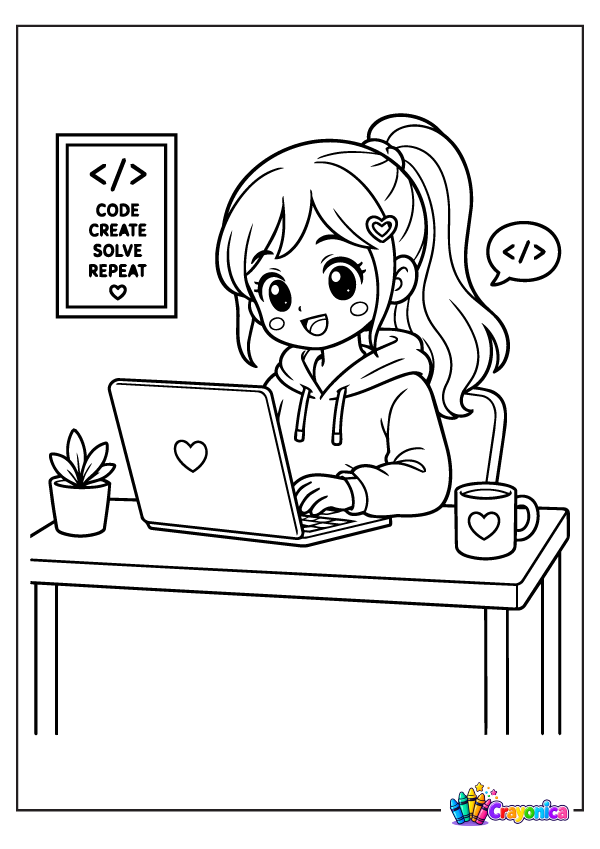
A Cute Girl Programmer Coloring Page introduces children to the world of coding through a friendly everyday scene. The young programmer sits at her desk with a laptop open in front of her, while familiar code symbols around the workspace hint at what she might be creating.
A small plant and cup make the setting feel like a comfortable place where ideas can grow. Children can choose colors for the laptop, hoodie, desk, and accessories while imagining what might be happening on the screen.
Maybe she is building a simple game. Perhaps she is creating a website, experimenting with an animation, or trying to solve a tricky coding problem.
The picture leaves that part of the story open for young artists to decide.
What Does a Programmer Do?
A programmer writes instructions that computers can follow. Those instructions are called code, and different programming languages provide different ways to describe what a computer should do.
Code can be used to create many things children already recognize, including websites, apps, games, digital tools, and software.
Programming is not simply typing mysterious symbols into a computer. A programmer often needs to understand a problem, break it into smaller pieces, create a solution, test what happens, and make changes when something does not work as expected.
For children, that process can be explained simply as create, test, solve, and try again.
Look for the Coding Clues
Several small details connect this illustration to programming.
The laptop is the most obvious one, but children can also spot </>-style code symbols in the picture. A poster behind the character even references creating, solving, and repeating—a playful reminder that making something with code often involves experimentation.
Parents can ask children what they think she might be making.
Could the laptop contain a colorful game? A website about dinosaurs? An app for drawing pictures? Maybe she is programming a tiny robot that exists just outside the illustration.
Questions like these connect technology with imagination rather than presenting computers as something children only use to watch or consume content.
Coding Can Be Creative
Programming and creativity often work together.
When someone creates a game, for example, they may need to think about characters, movement, rules, sounds, menus, and what should happen when a player makes a choice. Building a website can involve organizing information and deciding how people interact with a page.
Even solving a technical problem can require experimenting with several ideas before finding one that works.
Children do not need to know a programming language to understand that basic idea. They already practice similar thinking when they build something, solve a puzzle, invent rules for a game, or figure out why something is not working.
The coloring page gives that idea a visual character they can imagine becoming.
Design Her Coding Space
Children can give the programmer’s workspace its own personality. Her hoodie might use soft pastel shades, bold colors, or a completely unique combination. The laptop could match her clothes or stand out with a contrasting design.
The plant introduces natural greens, while the cup, desk, poster, and small decorations provide additional areas for experimentation.
Kids might even imagine what the laptop screen would look like if it were visible. What colors would their game use? What would their website be about?
That small storytelling exercise turns the page from a picture of someone using a computer into an invitation to imagine creating something with one.
From an Idea to a Solution
Technology projects often begin with an idea or problem. The next step is figuring out how to turn that idea into something that works.
That is one reason programming connects naturally with engineering. Both can involve planning, testing, problem-solving, and improving an idea over time.
Children may encounter those same habits long before they write their first line of code. Building blocks that keep falling, figuring out a puzzle, or changing the rules of a homemade game all involve trying ideas and learning from what happens next.
Introducing programming through familiar creative thinking can make technology feel more approachable and less abstract.
Conclusion
The Cute Girl Programmer Coloring Page combines technology with imagination through a young coder working at her laptop. Coding symbols and workspace details give children clues about programming while leaving the most exciting question unanswered: what is she creating?
Young STEM explorers can move from software ideas to physical design with the Cute Girl Engineer Coloring Page, then discover another workplace setting through the Office Boy Cleaning Coloring Page. Children interested in community careers can explore the Police Officer Girl Coloring Page and Firefighter Boy Coloring Page for Kids, while the Superhero Rescue Coloring Page for Kids turns creative problem-solving and helping others into an imaginative adventure.
FAQ
What does a programmer do?
A programmer writes and works with code to create or improve software, websites, apps, games, and other computer-based systems.
What is computer code?
Code is a set of instructions written in a programming language that tells a computer how to perform particular tasks.
What might the girl be creating on her laptop?
Children can imagine anything from a website or simple game to an app, animation, or another digital project.
Does programming involve problem-solving?
Yes. Programmers often identify problems, develop solutions, test their code, find errors, and make improvements.
Can programming be creative?
Absolutely. Coding can combine logical thinking with design, storytelling, experimentation, and imagination depending on what someone is creating.