Celebrate World Environment Day
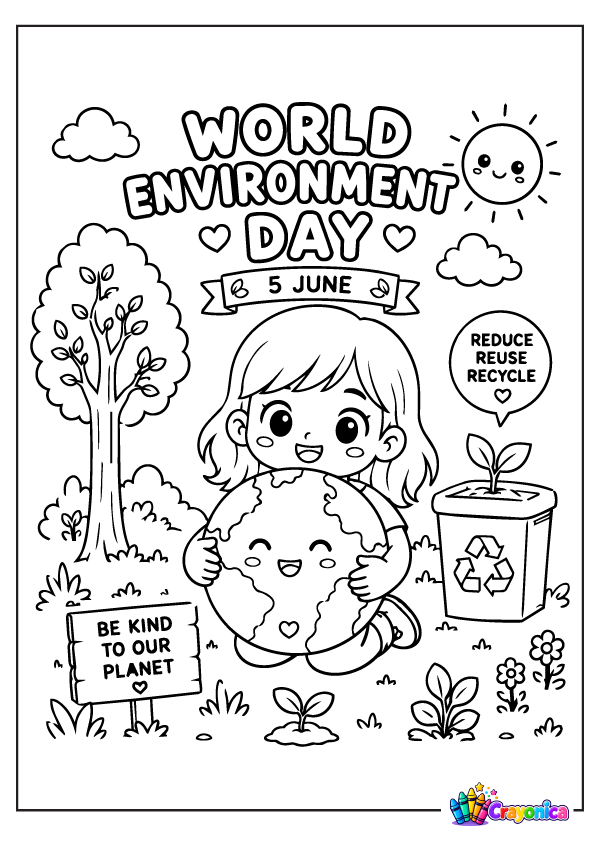
A World Environment Day Coloring Page gives children a creative way to explore nature and some of the everyday choices connected with caring for the environment. In this cheerful scene, a child hugs a smiling Earth surrounded by trees, flowers, grass, clouds, and environmental messages.
The illustration also displays June 5, the date World Environment Day is observed each year. Nearby, children can find a recycling bin and a reminder to reduce, reuse, and recycle.
Before coloring, parents or teachers can invite children to look around the scene. What plants can they find? Where is the recycling symbol? Why might the child be hugging the Earth?
Simple questions can turn the illustration into a conversation about the world around them.
What Is World Environment Day?
World Environment Day is observed every year on June 5 and was established by the United Nations in 1972. The first World Environment Day was celebrated in 1973.
Today, the annual event is used around the world to encourage attention and action on environmental issues. Different years may highlight different themes and environmental challenges.
For young children, the idea can stay much simpler.
World Environment Day can be an opportunity to notice trees, plants, animals, water, soil, and the places people share—and to think about everyday actions that can help care for those surroundings.
The coloring page introduces that idea visually without requiring children to understand complicated environmental topics.
Reduce, Reuse, and Recycle
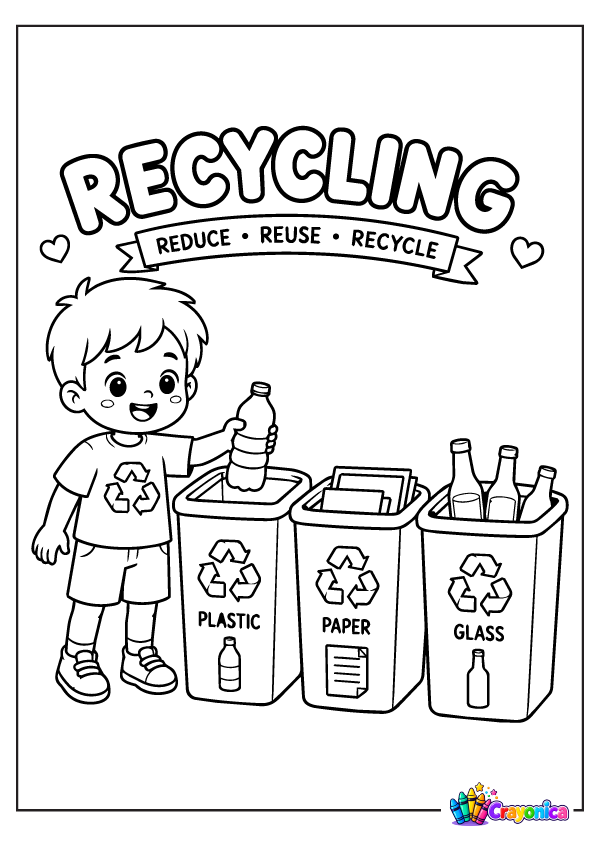
One of the messages visible in the illustration is reduce, reuse, recycle.
Reducing can mean using fewer unnecessary resources or creating less waste. Reusing means finding another purpose for something instead of immediately throwing it away. Recycling involves collecting suitable materials so they can be processed and used again.
Children might already recognize examples from everyday life.
A reusable bottle can be filled again. A cardboard box can become part of an art project. Paper, cans, or other materials may be recyclable depending on local recycling programs.
The recycling bin in the picture gives children an easy visual clue to begin that conversation.
Discover Nature Around the Earth
Trees, flowers, grass, clouds, and the smiling planet make nature an important part of this scene.
Children can choose different greens for the leaves and grass, add bright colors to the flowers, and decide how the land and oceans on their Earth should look. The surrounding landscape can become a sunny garden, a colorful park, or an imaginary place of their own.
Adults can also encourage children to notice nature where they live.
A tree outside a window, birds in a park, insects around flowers, rain, or even a small plant at home can become starting points for curiosity about the environment.
The subject does not need to feel enormous. For a child, discovering the planet can begin with noticing what is nearby.
Small Ways to Care for Shared Places
Environmental care can be introduced through actions children can understand rather than large problems they cannot solve themselves.
Putting litter in the appropriate bin, taking care of plants, using reusable items when practical, avoiding unnecessary waste, and respecting parks or other shared outdoor spaces are straightforward examples.
Different families, schools, and communities will have different routines and recycling systems, so adults can connect the picture with whatever practices make sense locally.
The goal is not to make children responsible for environmental problems. Instead, the page can help them recognize that everyday objects, resources, and natural spaces are worth noticing and caring for.
Create a Colorful Planet
Earth itself is the centerpiece, giving children plenty of room to experiment.
They might use familiar blue oceans and green land or create a completely imaginative planet filled with purple seas, orange islands, and rainbow forests. Trees and flowers can follow realistic colors or become part of that fantasy world.
Children can also imagine what their ideal environment would contain.
Would there be huge forests? Gardens filled with butterflies? Clean beaches? Mountains, rivers, animals, or enormous fields of flowers?
That gives the environmental theme room for creativity instead of turning the page into a lesson full of rules.
Conclusion
The World Environment Day Coloring Page combines Earth, trees, flowers, recycling, and the June 5 celebration in one nature-focused scene. Children can explore the details through color while learning simple ideas about reducing waste, reusing items, recycling where appropriate, and caring for shared spaces.
Kids can continue exploring outdoor environments with the Summer Beach Coloring Page for Kids, then discover ocean life through the Cute Girl Scuba Diving Coloring Page. For animal-focused nature adventures, the Baby Kraken Coloring Page introduces an imaginative sea creature, while the Cute Yeti Coloring Page takes the journey into a very different wilderness setting. The Cute Librarian Coloring Page can then connect curiosity about nature with books, information, and learning.
FAQ
When is World Environment Day?
World Environment Day is observed every year on June 5.
What is World Environment Day about?
It is an international observance focused on raising awareness and encouraging action related to environmental issues.
What can children find in this coloring page?
The scene includes a child hugging Earth, trees, flowers, grass, a recycling bin, clouds, the sun, and environmental messages.
What does reduce, reuse, recycle mean?
Reduce means trying to create less waste, reuse means using an item again or finding another purpose for it, and recycle means processing suitable materials so they can be used again.
Can children use imaginary colors for Earth?
Of course. They can use familiar colors or invent their own colorful planet with imaginative oceans, land, plants, and scenery.